Short answer: in Nevada, most sellers must complete a Seller’s Real Property Disclosure Form. One question asks whether you’re aware of environmental hazards — and it names asbestos as an example. You disclose what you know; you’re not required to test. But once you know your ceiling contains asbestos, it’s a known condition and you should expect to disclose it.
This guide explains what the form asks, what “known” really means, and how to present an asbestos ceiling so it doesn’t scare buyers away.
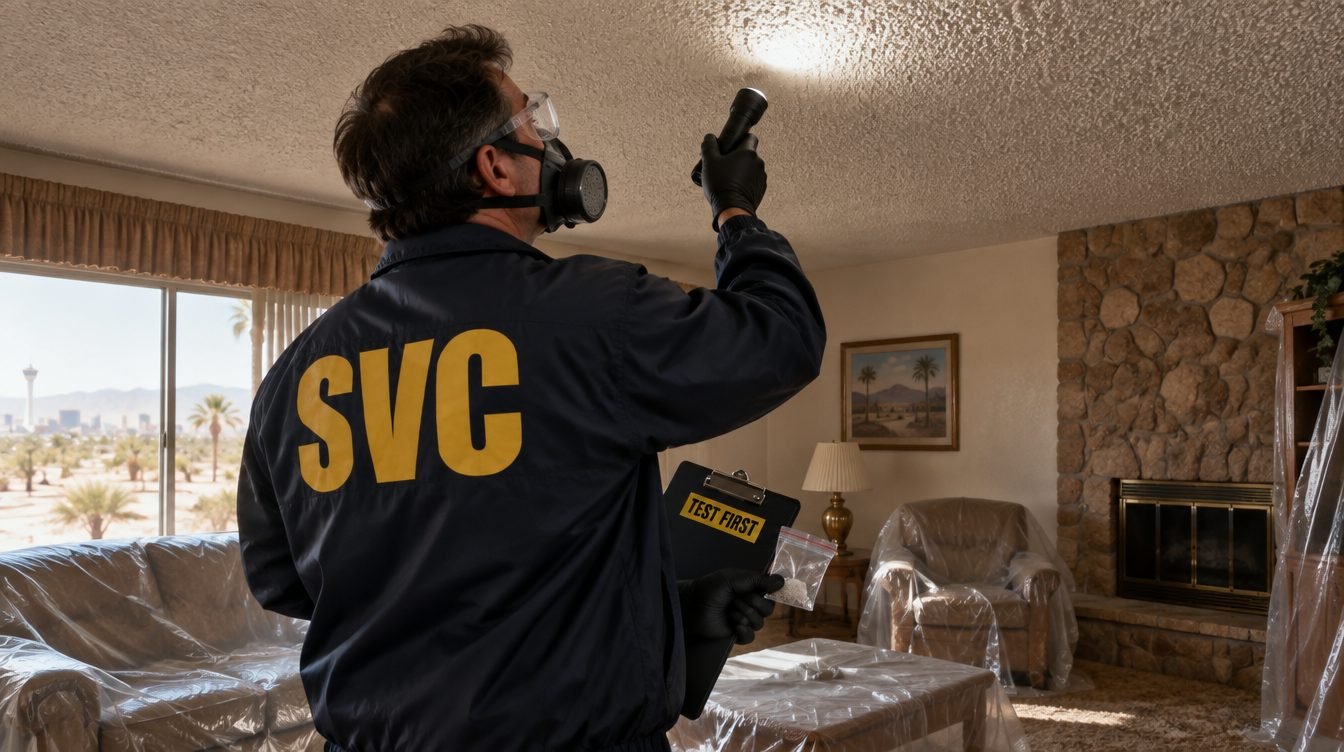
TEST FIRST. Popcorn ceilings in homes built before the mid-1980s may contain asbestos. Don’t scrape, sand or drill before a lab test. This article is general information — not legal or real estate advice. Ask your agent and, for legal questions, a Nevada real estate attorney.
When was your home built?
Not sure? Check your year in 10 seconds →
What the Nevada Disclosure Form Asks
The Seller’s Real Property Disclosure Form (current version dated 6/1/2023) includes an environmental question asking about:
“Any substances, materials, or products which may be an environmental hazard such as but not limited to, asbestos, radon gas, urea formaldehyde, fuel or chemical storage tanks, contaminated water or soil on the property?”
The form’s instructions tell sellers to report known conditions affecting the property. Nevada law (NRS 113.140) also says a seller doesn’t have to disclose a defect they’re not aware of. And the form notes that sellers generally haven’t inspected inaccessible areas.
What “Known” Means in Real Life
| Your situation | What it usually means |
|---|---|
| Never tested, no reason to think it has asbestos | Answer honestly with what you know. Ask your agent how to word it. |
| A lab test found asbestos | It’s a known condition. Expect to disclose it. |
| A lab test came back clear | Sharing the report can reassure buyers. |
| You had asbestos removed by a licensed company | Talk to your agent about disclosing the history and sharing the paperwork. |
| You sealed or covered an asbestos ceiling | The material is still there — expect to disclose it. |
| A contractor told you it might contain asbestos | Ask your agent or an attorney how to answer. |
“Should I Just Not Test So I Don’t Have to Disclose?”
It’s a fair question, and a lot of sellers wonder it. Here’s the honest picture:
- The law is about what you know. You aren’t required to test.
- But buyers can test. Many buyers’ inspectors flag popcorn ceilings in older homes and recommend testing. If a test happens during escrow, you learn the result anyway — on the buyer’s timeline, not yours.
- Late surprises cost leverage. A positive result in the middle of escrow can lead to renegotiation, delays or a cancelled sale.
- Knowing puts you in control. With a result and a quote in hand, you decide how to handle it before buyers do.
If you’re unsure how testing affects your obligations, talk to a Nevada real estate attorney before you list.
What Your Agent Has to Disclose
Nevada real estate licensees must disclose material facts about a property that they know about. They generally aren’t required to inspect or independently verify what the seller says. If your agent knows about an asbestos test result, expect them to treat it as a material fact.
How to Present an Asbestos Ceiling to Buyers
A disclosed, documented condition is far less scary than a mystery. Put together a simple folder for buyers:
- The lab report — what was tested, where, and the result.
- Your options and costs — a written quote for removal, sealing or covering.
- Work completed — abatement invoice, the company’s license number and clearance results, if you had it removed.
- Condition notes — no water damage, cracking or crumbling.
- Your completed disclosure form.
Buyers and their agents usually respond better to “here’s exactly what it is and what it costs” than to an unanswered question.
Your Options After You Know
- Remove it before listing with a licensed abatement company — about $4–$20 per sq ft for asbestos work (2026 national averages).
- Seal or cover it — usually less expensive; the material stays in place and is still disclosed.
- Sell as-is and price it in — common for investor or fixer-upper sales.
- Offer a credit — based on a written quote.
Compare them in Remove, Seal or Cover Before You Sell?
Who’s Exempt From the Form?
Some sales don’t require the form — for example, certain foreclosure sales and certain transfers between co-owners, spouses or close relatives. Even exempt sellers can’t commit fraud. Ask your agent whether your sale requires the form.
A Simple Timeline: Test, Decide, Disclose
- Before listing: check your build year. If it’s before the mid-1980s, consider testing.
- Get results: decide whether to remove, seal, cover or sell as-is.
- Get paperwork together: lab report, quotes, any invoices and clearance results.
- Complete the disclosure form with your agent’s guidance, answering what you know.
- Share your documents with buyers when they ask — or proactively, if your agent recommends it.
Doing these steps before you list means buyers see a handled, documented condition instead of an open question.
Selling a Rental or Inherited Home
Rentals and inherited homes raise extra questions. If tenants live in the home, removal work affects them and may need coordination and notice — ask your property manager or attorney. If you’re selling a home you inherited, you may know very little about its history. Answer the disclosure form based on what you actually know, gather any old paperwork you can find, and ask a Nevada real estate attorney how the disclosure rules apply to your situation.
Why Documentation Builds Buyer Trust
Buyers can’t see inside a ceiling. Documents are how you show them what’s there and what was done about it. A lab report, a licensed company’s invoice and clearance results turn “maybe asbestos” into “tested, handled, documented.” Keep copies for yourself too — you’ll want them if questions come up after closing.
Disclosure Mistakes to Avoid
- Guessing. If you don’t know, don’t invent an answer either way.
- Forgetting old paperwork. Past test results or contractor notes count as things you may know.
- Hiding a known condition. That can lead to legal claims after closing.
- Disturbing the ceiling before listing. DIY scraping can turn a disclosure question into a contamination problem.
Disclosure by Build Year
Find your home’s year on the Clark County Assessor website (Nye County for Pahrump), then use this quick guide. Check your year →
| Home built | What it means for you |
|---|---|
| Before 1980 | Buyers’ inspectors often flag these ceilings. Consider testing before you list so you’re not surprised. |
| 1980–1986 | Also likely to be flagged. Testing before listing gives you control over the answer. |
| 1987–1999 | Less likely to be flagged. Your build year answers many buyers’ questions. |
| 2000 or newer | Rarely an issue. Answer the form based on what you know. |
Disclosure Questions
Do I have to disclose asbestos when selling a house in Nevada?
Nevada’s Seller’s Real Property Disclosure Form asks whether you’re aware of environmental hazards and lists asbestos as an example. You disclose what you know. If you know your ceiling contains asbestos, expect to disclose it.
Do I have to test for asbestos before selling?
No. Nevada sellers aren’t required to test. The form covers conditions you know about. Many sellers test anyway so they can answer buyers’ questions with facts.
If I removed the asbestos, do I still need to disclose it?
Talk to your agent. Many sellers disclose past asbestos work and share the abatement invoice and clearance results — buyers usually see that as a plus, because it shows the problem was handled properly.
What if I’m not sure whether my ceiling has asbestos?
Answer the form honestly based on what you know. If you’re unsure how to answer, ask your agent or a Nevada real estate attorney before you sign.
Can my agent fill out the disclosure form for me?
The form is the seller’s statement. Your agent can explain it, but you’re the one who signs and answers based on your own knowledge.
What happens if I don’t disclose something I knew about?
A seller who knowingly leaves out a known condition may face legal claims from the buyer. If you’re worried about a past disclosure, talk to a Nevada real estate attorney.
Sources
- HomeGuide — Popcorn Ceiling Removal Cost
- Angi — Popcorn Ceiling Removal Cost
- Nevada Real Estate Division — Seller Real Property Disclosure Form
- NRS 113.130 (Justia)
- HomeData Reports — Nevada Seller Disclosure Under NRS 113
Know before you disclose
A test answers the question on your timeline. We’ll set it up and connect you with licensed pros for any work.
About SVC: Smooth Vegas Ceilings connects Las Vegas homeowners with licensed, insured contractors and properly licensed asbestos testing and abatement companies. SVC is not a real estate brokerage or law firm and does not give legal, real estate or medical advice. SVC does not perform asbestos abatement.
Leave a Reply