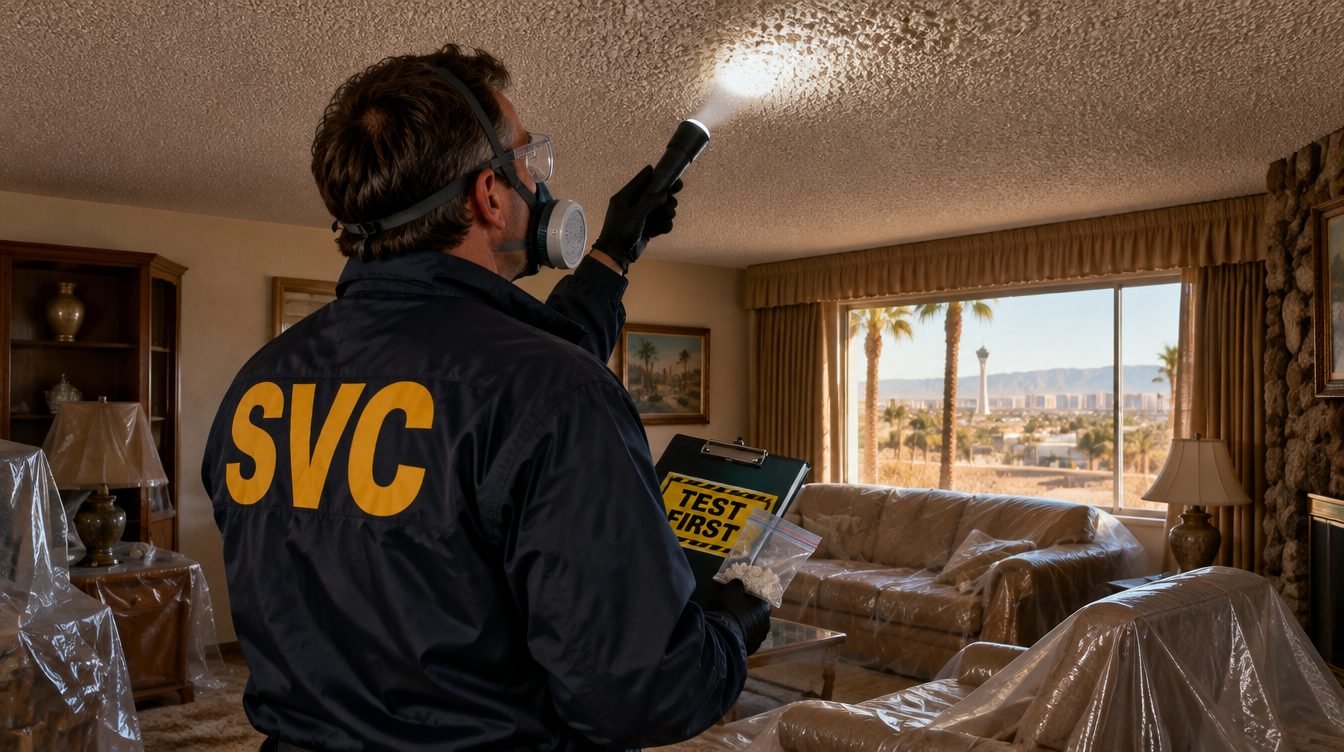
Short answer: in most cases, no one did anything illegal. Asbestos popcorn ceilings were legal and standard when most older homes were built. Builders are usually protected by time limits, sellers only have to disclose what they knew, and realtors generally don’t have to test. The exception is when someone knew about asbestos and hid it — then a Nevada attorney can tell you your options.
Finding out your ceiling may contain asbestos is frustrating. It’s natural to look for someone to hold responsible. Here’s how responsibility actually works in Nevada — in plain English — so you can spend your energy on the right next step.
Not legal advice. This article explains general rules. Laws change and every situation is different. For advice about your case, talk to a Nevada real estate attorney. For health concerns, talk to your doctor.
When was your home built?
Not sure? Check your year in 10 seconds →
At a Glance: Who’s Usually Responsible?
| Who | Usually responsible? | Why |
|---|---|---|
| Home builder | Rarely | It was legal at the time, and Nevada’s construction defect time limit is generally 10 years. |
| Product manufacturer | Sometimes, for illness | Claims are usually tied to an asbestos-related disease, not just its presence in a ceiling. |
| Seller | Only if they knew | Sellers disclose known conditions; they don’t have to test. |
| Real estate agent | Only if they knew | Agents disclose known material facts; they don’t have to investigate. |
| Home inspector | Rarely | Standard inspections usually don’t include asbestos testing. |
| You, the current owner | For what happens next | Managing it safely — and disclosing it when you sell. |
The Builder
Most homeowners’ first instinct is to blame whoever built the house. But for homes built before the asbestos bans took effect, the builder was usually following normal, legal practice. Spray-on ceiling texture was a product they bought from a manufacturer and applied like everyone else did. Read why your home has asbestos for the full history.
There’s also a time limit. Nevada’s statute of repose for construction defect claims (NRS 11.202) is generally 10 years from substantial completion of the home. For a house built in the 1970s or early 1980s, that window closed decades ago.
Bottom line: a claim against the original builder for an asbestos ceiling in an older home is usually a dead end. A Nevada attorney can confirm whether anything unusual about your situation changes that.
The Product Manufacturer
Historically, most asbestos lawsuits have targeted the companies that made asbestos products, not homebuilders. Those cases are usually about people who developed an asbestos-related illness. Many of those manufacturers went bankrupt and set up trust funds to pay injury claims.
Simply having asbestos in your ceiling generally isn’t a claim by itself. Legal claims in this area are usually connected to a medical diagnosis. If you have health concerns, start with your doctor.
The Seller
Nevada requires most home sellers to complete a Seller’s Real Property Disclosure Form (NRS Chapter 113). The form asks whether the seller is aware of environmental hazards — and it lists asbestos as an example.
Here’s the key: the form covers conditions the seller knows about. Nevada law says a seller doesn’t have to disclose a defect they’re not aware of, and sellers aren’t required to test for asbestos.
- Seller never tested, didn’t know: generally not the seller’s fault.
- Seller had a test showing asbestos and checked “no”: that may be a disclosure problem. Talk to an attorney.
- Seller disclosed it and you didn’t notice: check your closing documents — it may be in your paperwork.
The Real Estate Agent
Nevada real estate licensees must disclose material facts about a property that they know about. They generally aren’t required to inspect, test, or independently verify what the seller says.
So unless your agent actually knew about asbestos and kept quiet, they usually aren’t responsible. A good agent will often recommend testing for older homes — it’s a smart question to ask before you buy.
The Home Inspector
A standard home inspection is a visual check. It usually doesn’t include lab testing for asbestos, mold or other environmental hazards. Some inspectors note materials that may contain asbestos and recommend testing.
Pull out your inspection report. If it recommended testing, that’s useful information — and a reminder that testing is the step that answers the question.
If You Think Someone Hid It
- Gather your documents: purchase contract, Seller’s Real Property Disclosure Form, inspection report, and any emails or texts.
- Get the ceiling tested so you know what you’re dealing with. Keep the lab report.
- Don’t disturb the ceiling while you sort it out.
- Write down what you know: who said what, and when.
- Talk to a Nevada real estate attorney promptly. Legal deadlines apply, and they may be shorter than you think.
Where to Put Your Energy Instead
For most homeowners, the honest answer is that nobody’s to blame — it was the building practice of the time. Chasing blame can cost months and legal fees with little to show for it. The good news is that the fix is straightforward:
- Test first — about $250–$850 for a professional test (national average).
- Choose your option — regular removal if clear; licensed abatement, sealing or covering if asbestos is found.
- Check your insurance if a burst pipe, fire or storm damaged the ceiling. See does homeowners insurance cover asbestos removal?
- Keep every record — test results, invoices and clearance reports.
Buying an Older Home? Protect Yourself Up Front
If you’re shopping for a home built before the mid-1980s, a few simple steps during escrow can save you a surprise later:
- Read the seller disclosure form closely, especially the environmental hazards question.
- Ask the seller directly whether the ceilings have ever been tested, and ask for any reports.
- Order an asbestos test during your inspection period if you plan to remodel. It’s a small cost compared to the price of the home.
- Ask your agent about adding a testing contingency to your offer, so the result can shape your decision or your negotiation.
- Get repair estimates before closing if the test comes back positive, so you know the real cost of the house.
A popcorn ceiling isn’t a reason to walk away from a good home. Knowing what’s in it — before you sign — just puts you in control.
When It’s Your Turn to Sell
Once you know your ceiling contains asbestos, it becomes a known condition — and you should expect to disclose it on the Nevada seller disclosure form. That’s another reason to keep good records. A buyer who sees a lab report, a licensed abatement invoice and a clearance result usually has far fewer worries than one who sees a question mark. Ask your agent how to handle disclosure for your home.
Responsibility by Build Year
Find your home’s year on the Clark County Assessor website (Nye County for Pahrump), then use this quick guide. Check your year →
| Home built | What it means for you |
|---|---|
| Before 1980 | Asbestos texture was legal and common. Builder claims are long past Nevada’s time limits. |
| 1980–1986 | Builders could legally use up existing supplies. Same story — focus on testing and disclosure. |
| 1987–1999 | Asbestos is less likely. If you suspect it, test before blaming anyone. |
| 2000 or newer | Asbestos is very unlikely. For other defects in a newer home, Nevada’s 10-year time limit may still matter — ask an attorney. |
Responsibility & Disclosure Questions
Can I sue my builder for asbestos in my popcorn ceiling?
Usually it’s very difficult. For older homes, asbestos texture was generally legal and standard when it was installed, and Nevada’s construction defect statute of repose is generally 10 years from completion. A Nevada attorney can tell you whether any exception applies to your situation.
Did the seller have to tell me about asbestos?
Nevada’s Seller’s Real Property Disclosure Form asks about environmental hazards, including asbestos. But sellers disclose what they know — they don’t have to test, and they aren’t required to disclose defects they weren’t aware of.
Is my realtor responsible for not telling me?
Nevada real estate licensees must disclose material facts they know about, but they generally aren’t required to investigate or test the property. If the agent didn’t know, they usually aren’t responsible.
Should my home inspector have found it?
Standard home inspections usually don’t include asbestos lab testing. Inspectors may note materials that could contain asbestos and recommend testing. Check your inspection report and the inspector’s agreement.
What if the seller knew and hid it?
If you have evidence a seller knew about asbestos — for example, a test report — and didn’t disclose it, you may have legal options. Deadlines apply, so talk to a Nevada real estate attorney soon.
Do I have to tell buyers when I sell?
If you know your ceiling contains asbestos, expect to disclose it on Nevada’s seller disclosure form. Removal or abatement records help show buyers how it was handled. Ask your agent.
Keep Reading
- Why Does My Home Have Asbestos? The Story Behind Popcorn Ceilings
- Does Homeowners Insurance Cover Asbestos Removal?
- Asbestos Exposure Check
- How SVC Vets Every Pro
Sources
- Nevada Real Estate Division — Seller Real Property Disclosure Form
- Nevada Revised Statutes Chapter 113 (seller disclosure)
- Gordon Rees — Nevada’s 10-year statute of repose for construction defects
- FindLaw — Asbestos in the Home: Liability and Lawsuits
- U.S. EPA — U.S. Federal Bans on Asbestos
Get answers, not blame
A test tells you exactly what you’re dealing with. We’ll set it up and connect you with a licensed local pro.
About SVC: Smooth Vegas Ceilings connects Las Vegas homeowners with licensed, insured contractors and properly licensed asbestos testing and abatement companies. SVC is not a law firm and does not give legal, insurance or medical advice. SVC does not perform asbestos abatement.
Leave a Reply