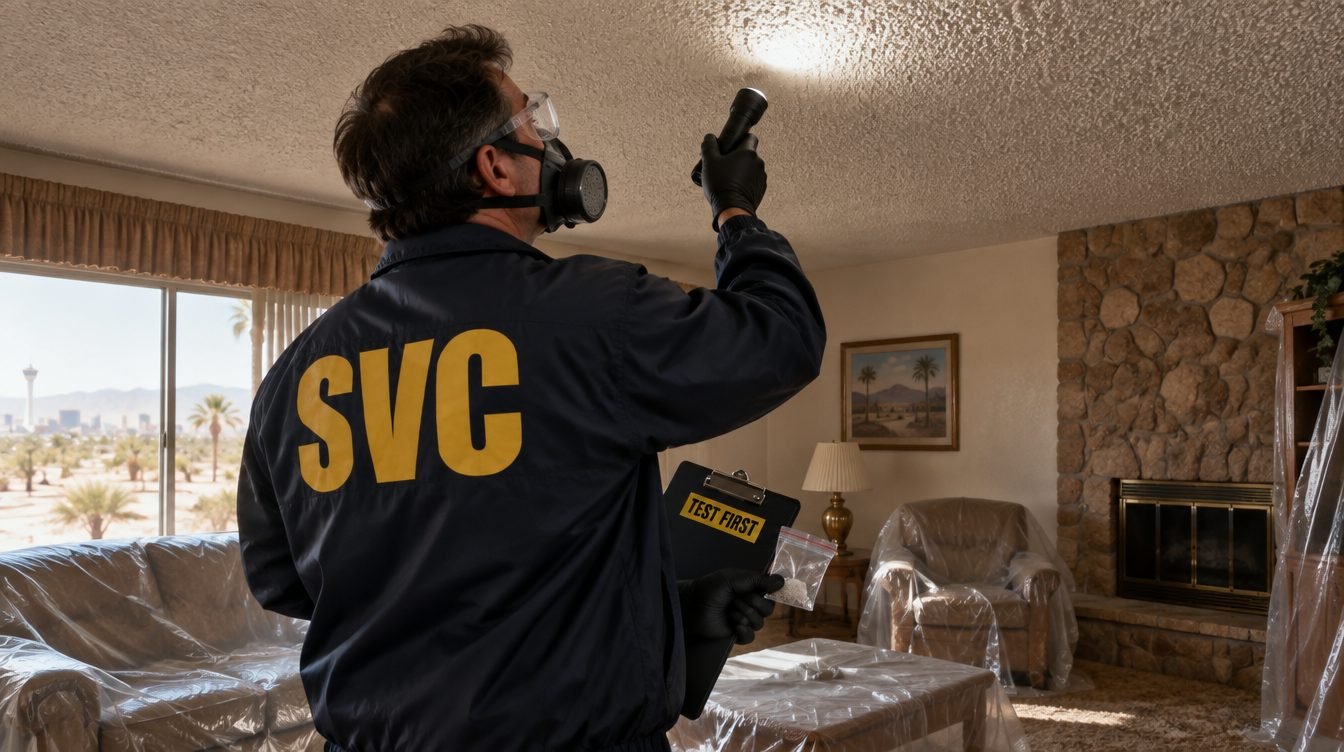
Short answer: your home probably has asbestos in its popcorn ceiling because, when it was built, that was normal. For decades, asbestos was a cheap, fireproof ingredient in spray-on ceiling texture. It was legal, widely used, and nobody was hiding anything. Federal bans on spray-applied asbestos came in the 1970s — but builders could use up existing supplies, which is why homes built into the mid-1980s can still have it.
If you just found out your ceiling might contain asbestos, it’s natural to feel blindsided — and to wonder who’s to blame. This guide explains how it got there. Our companion article covers who’s responsible today: the builder, seller or realtor.
TEST FIRST. You can’t tell by looking. If your home was built before the mid-1980s, don’t scrape, sand or drill the ceiling until a sample is tested. Take the 60-second exposure check →
When was your home built?
Not sure? Check your year in 10 seconds →
Quick Facts
- Most at risk: homes built before about 1986.
- Main ban: spray-applied asbestos surfacing, 1978 — but existing supplies could still be used.
- Lower risk: popcorn ceilings from the 1990s and later.
- Only real answer: an accredited lab test, typically about $250–$850.
- Biggest danger: scraping, sanding or drilling before testing.
- Who was at fault? Usually no one — it was legal, standard practice at the time.
Why Popcorn Ceilings Were Everywhere
Popcorn ceilings — also called acoustic, stucco or cottage-cheese ceilings — were popular in American homes for decades, roughly from the 1950s into the 1980s. Builders loved them for practical reasons:
- Fast and cheap. Spraying texture on a ceiling took far less time than taping and sanding drywall to a smooth finish.
- Hides flaws. The bumpy texture covered seams, uneven drywall and small mistakes.
- Quieter rooms. The rough surface helped soften echo and sound — that’s why it’s also called an acoustic ceiling.
- It was the style. Homebuyers expected it. A textured ceiling looked finished and modern for its time.
Why Asbestos Was in the Mix
Asbestos is a natural mineral made of tiny fibers. For most of the 20th century, it was considered a miracle material. Manufacturers added it to hundreds of building products because it:
- Resists heat and fire
- Adds strength and binds materials together
- Was inexpensive and easy to get
Some spray-on ceiling texture products contained asbestos. The homebuilder usually didn’t mix the material — they bought a product from a manufacturer and sprayed it on, the same way every other builder did.
When It Stopped: A Simple Timeline
| Year | What happened |
|---|---|
| 1973 | EPA bans spray-applied asbestos used for fireproofing and insulation. |
| 1977 | Consumer Product Safety Commission bans asbestos in wall patching compounds and artificial fireplace embers. |
| 1978 | EPA bans spray-applied asbestos surfacing materials for the remaining uses — including decorative spray-on products. |
| Late 1970s–mid 1980s | Builders could still install existing stock, so asbestos texture shows up in homes built during these years. |
| 1989 | EPA issues a broad asbestos ban. |
| 1991 | A federal court overturns most of the 1989 ban. Some bans stay in place. |
| 2024 | EPA finalizes a ban on chrysotile asbestos, the last type still used in the U.S. |
What this means for you: if your home was built before about 1986, test the ceiling before any work. Homes built later are much less likely to have asbestos texture, though popcorn ceilings kept being sprayed into the 1990s without it.
Why Las Vegas Has Both Kinds of Homes
Las Vegas grew in waves. The older neighborhoods near downtown, Huntridge, Charleston Heights and parts of North Las Vegas and Henderson include many homes from the asbestos era. Boulder City has a large share of older homes too.
Much of the valley — Summerlin, much of Henderson, and the newer northwest and southwest — was built later, after asbestos texture had been phased out. But plenty of those homes still have popcorn ceilings, just without the asbestos. That’s why the build year is your first clue and a lab test is the only real answer.
How to Find Your Home’s Build Year
- Look up your address on the Clark County Assessor website (Nye County Assessor for Pahrump).
- Check your purchase or closing documents.
- Ask your realtor, or check the listing history.
- Remember: additions and remodels may be newer or older than the original house.
Where Else Asbestos Can Hide in Older Homes
Popcorn ceilings get the attention, but older homes can have asbestos in other materials too, such as:
- Drywall joint compound and some textured paints
- Old vinyl floor tiles and the adhesive under them
- Pipe, duct and furnace insulation
- Some roofing and siding materials
If you’re planning a bigger remodel, ask your tester about checking other materials you’ll be cutting or removing.
Why Nobody Told You When You Bought the House
Many homeowners only learn about asbestos when they’re about to remodel. That’s usually not because someone hid it. In Nevada, sellers disclose the conditions they know about — they aren’t required to test. A standard home inspection usually doesn’t include asbestos lab testing either. So if nobody ever tested the ceiling, nobody actually knew.
If you believe someone did know and kept it from you, that’s a different situation. Our article on who’s responsible for asbestos in your home explains how disclosure works and when to talk to an attorney.
Common Myths About Asbestos Popcorn Ceilings
- Myth: “Every popcorn ceiling has asbestos.” Not true. Many popcorn ceilings — especially from the 1990s on — don’t. Only a test tells you.
- Myth: “If it has asbestos, I have to remove it right away.” Not necessarily. An intact, undisturbed ceiling is generally lower risk. Sealing or covering can be options.
- Myth: “Painting over it makes it safe forever.” Paint can help seal it, but scraping or drilling a painted ceiling still disturbs what’s underneath — and paint makes removal harder later.
- Myth: “A little scraping won’t matter.” Small jobs can still release fibers. Test before you touch it, no matter how small the project.
- Myth: “I can tell by the color or texture.” Asbestos fibers are microscopic. White, gray, sparkly or plain — looks don’t tell you anything.
Is It Dangerous Right Now?
An asbestos popcorn ceiling in good shape that nobody touches is generally lower risk. The concern is when it’s disturbed — scraped, sanded, drilled, water-damaged or crumbling — and fibers get into the air.
If you’re worried about your health, talk to your doctor and mention the possible exposure. Only a doctor can evaluate your health.
What to Do Next
- Check your build year. Before about 1986? Treat it as suspect.
- Don’t disturb the ceiling — no scraping, sanding, drilling or hanging things from it.
- Get it tested by a professional. A test typically costs about $250–$850 (national average).
- Choose your option: clear result means regular removal; asbestos found means licensed abatement, sealing or covering.
- Keep the paperwork. Test results and removal records help when you sell.
What Your Build Year Means
Find your home’s year on the Clark County Assessor website (Nye County for Pahrump), then use this quick guide. Check your year →
| Home built | What it means for you |
|---|---|
| Before 1980 | Most likely era for asbestos popcorn ceilings. Test before any work. |
| 1980–1986 | Possible — leftover supplies could still be installed after the 1978 ban. Test first. |
| 1987–1999 | Less likely. Popcorn was still popular, but asbestos texture had been phased out. Test if unsure. |
| 2000 or newer | Very unlikely. Removal is usually a standard job. |
Questions About Asbestos in Older Homes
What years did popcorn ceilings have asbestos?
Asbestos was commonly used in spray-on ceiling texture for decades before the late 1970s. Spray-applied asbestos surfacing was banned in 1978, but existing supplies could still be used, so homes built into the mid-1980s can have it. Popcorn ceilings from the 1990s and later are much less likely to contain asbestos.
Why did builders use asbestos in popcorn ceilings?
Asbestos was cheap, fire-resistant and added strength to the spray texture. Popcorn texture itself was popular because it was fast to apply, hid drywall imperfections, and helped dampen sound. At the time, it was legal and standard practice.
Was it illegal for my builder to use asbestos?
For homes built before the federal bans took effect, using asbestos-containing texture was generally legal and common. That’s why most homes with asbestos popcorn ceilings weren’t built that way by mistake.
My house was built in 1990. Can it still have asbestos?
It’s much less likely, but not impossible — remodels, additions and other materials can vary. If you’re unsure, a lab test is the only way to know.
Is asbestos still legal in the U.S. today?
Most uses have been restricted for decades. In 2024, the EPA finalized a ban on chrysotile asbestos, the only type still being imported and used in the U.S.
Can I tell if my ceiling has asbestos by looking at it?
No. Asbestos fibers are microscopic. Only a sample tested by an accredited lab can confirm it.
Keep Reading
- Who’s Responsible for Asbestos in My Home — Builder, Seller or Realtor?
- Does Homeowners Insurance Cover Asbestos Removal?
- Asbestos Popcorn Ceiling: Testing & Safety
- Asbestos Removal Cost: Remove, Seal or Cover
Sources
- U.S. EPA — U.S. Federal Bans on Asbestos
- U.S. EPA — Learn About Asbestos
- U.S. Consumer Product Safety Commission — Asbestos in the Home
Find out what’s in your ceiling
A quick test answers the question for good. We’ll set it up and connect you with a licensed local pro.
About SVC: Smooth Vegas Ceilings connects Las Vegas homeowners with licensed, insured contractors and properly licensed asbestos testing and abatement companies. SVC does not perform asbestos abatement and does not give legal or medical advice.
Leave a Reply